New Papyrus Co./Iberian Publishing
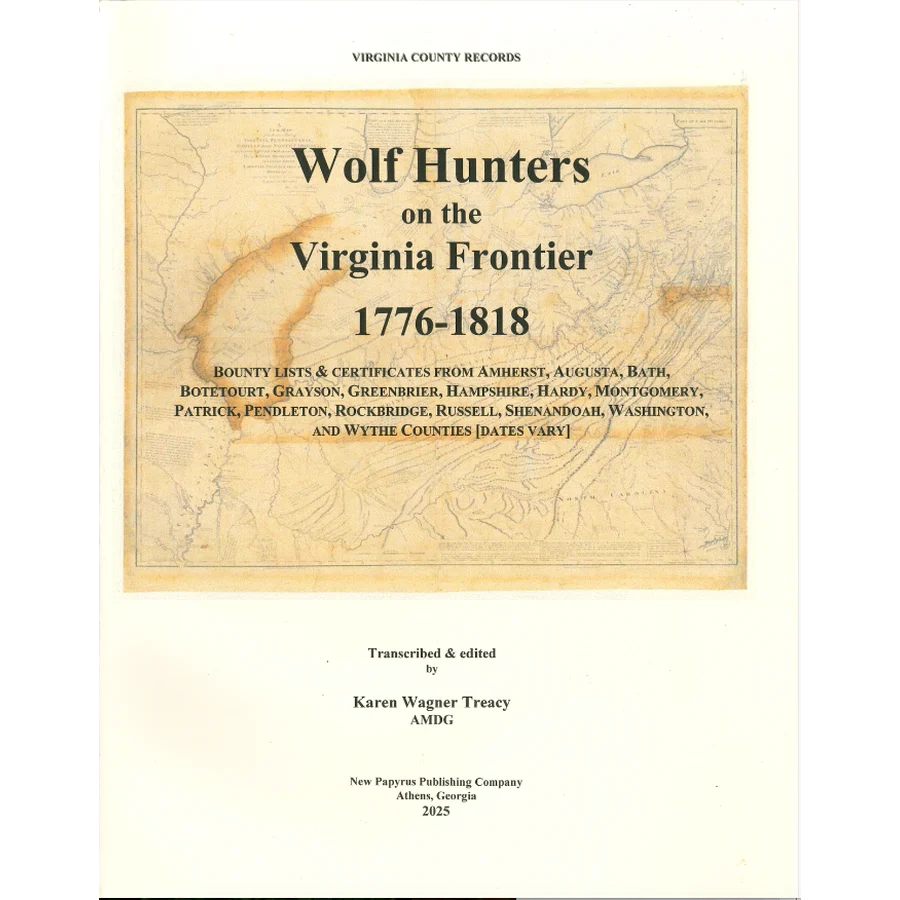
Wolf Hunters on the Virginia Frontier, 1776-1818
Wolf Hunters on the Virginia Frontier, 1776-1818
Couldn't load pickup availability
Karen Wagner Teacy
Locating an ancestor on the Virginia frontier in the late colonial and early republican period can be a daunting task. As the historian and archivist Robert Clay once remarked in a lecture, an individual he was researching in Virginia’s frontier region "appeared in a random document one morning, fully grown, and disappeared the following morning never to be heard from again.”
Oftentimes, early frontiersmen created few records and left little trace of their passing. Nowhere is this more evident than in the rapidly changing frontier west of the Blue Ridge. Starting with a trickle of settlers, there probably were no more than 160 families residing west of the mountains by 1735. By 1776 and the American Revolution, the number of settlers had grown to tens of thousands, attracted by the rich soils and pasture lands of the Shenandoah Valley and beyond, into Kentucky.
As the new government sought to bring order to the region, parent counties like Augusta and Lunenburg, which originally were little more than artificial lines when first drawn by surveyors in the wilderness, underwent division and subdivision into smaller political units to accommodate the new settlers. The trio of counties on Virginia’s frontier in the early 1740s [Frederick, Augusta, Lunenburg] would be divided and further subdivided over the next seven decades into more than sixty political units.
Author Karen Treacy has discovered an enlightening and unexpected record in the bounty system for wolf hunters. Early farmers and herders sought legislative relief from the scourge of wolf packs. The Virginia legislature responded by establishing the bounty system. In a time when an average laborer’s earning was $6-10/month, the $1 to $6 or 100# tobacco from a wolf scalp (depending on the currency and inflation of the time) was an attractive economic draw for every class of frontiersman, even those constantly moving folk mentioned by Clay.
This book is an important record not only for the two and a half thousand individuals cited but also for a valuable historical window into the activities and growth of Virginia’s frontier society.
2025, 8.5" x 11, paper, index, 169 pp.
Share